I’ve never been diagnosed with psychosis—quite the opposite.
Multiple psychiatrists found me fatigued, but sane. I had to know for myself if my experiences were are a part of some sort of a mental breakdown.
One psychiatrist suggested I might be the victim of a vendetta, and at our last session, he said he may take my case to the FBI himself. He asked me if I had any ideas who might have a vendetta with that kind of money and backing to come at me again and again. I gave him a name.
I was level-headed enough to have my mental health checked—because crime wasn’t just happening around me. It was following me. And it almost shut me down. So I sought a mental health check. If you are the victim of organized crime, I beg and plead with you to start there. A psychiatrist at the local hospital, after I checked myself in, looked me in the eye and said, “Tonia, I believe every word out of your mouth. But we’re not the FBI. What can I do for you once you check out?” I said simply, “Please remember my story if I am found dead in a ditch.” I checked myself into a voluntary mental health facility, but not for mania. I was approved for check in due to extreme fatigue. The intake doc just wanted me to get some rest in a safe environment.
I had been carrying this load for too long, and I did leave that short stint in the hospital with a diagnosis of PTSD due to the crime that had been following me, seemingly tracking me everywhere. That psychiatrist’s words meant everything to me that day.
“Tonia, I believe you.”
Those words were momentous. During the session, I kept saying, “I know all this sounds crazy…” The doctor finally stopped and said, “People who are crazy don’t think their stories sound crazy to others.”
One of my dearest friends said to me, “Just because a story sounds crazy, does not make it untrue,” and then she went on to tell me one of the craziest story of hers.
Those were all healing words.
And for the past few months, I’ve been building up the courage to tell my story—publicly. Even if I know it all sounds crazy. Even if it risks losing all the credibility I have worked hard to establish during my career, with my friends and family, and throughout my life. I’m doing it because I had forgotten I have a voice, and platforms to speak on. I had forgotten people have paid me a lot of money to do hour long speaking engagements in the past. I had forgotten who I was and that was exactly what my perpetrators wanted. To shut me down. To make me go away once I started recognizing all the patterns on how this kind of organized crime works. They knew I knew.
So here’s my big question?
How can thousands and thousands of people across the US be reporting the exact same phenomena’s and experiences without being taken seriously? How are the stories of stalking all so similar?
Is it easier to put what they call “organized gang stalking” or “electronic harassment” into the psychosis category, thereby continuing to victimize the victims, rather than putting the resources behind the investigations to nail what is lurking behind the curtain of sanctity and safety here in the U.S?
It began with my stolen SUV.
Then came an attempted break-in at my home.
A lens cap found outside on a table pushed close to the door of my office, back then, in Old Town Camarillo.
Then a woman crouching suspiciously in her vehicle on my street.
Then reports of package thefts in the neighborhood.
Then, a home across the street was burglarized—by Chilean Nationals, according to police.
I responded by launching a Neighborhood Watch.
My neighbors and I worked together. We shut it down.
And maybe that’s the kind of vendetta the doc was describing.
Or maybe I’m just a walking, talking, forever-victim of crime.
Because when I moved—
Crime followed me to Santa Barbara.
And then again to a second home in Indiana where I was terrorized. And the people who tried to help me were terrorized, and that terror continued even after I quite literally fled my home.
I’ve documented:
A stolen SUV. Auto tampering. Multiple police and incident reports. A neighbor’s burglary. Security alarms going off only a night while I was home alone. Drone landings on my property. Low flying aircraft. Diverted calls—confirmed by a town official. And the list goes on and on, and on.
This isn’t paranoia.
It’s a paper trail—photographic, digital, and meticulously kept when I wasn’t being hacked.
Maybe the narrative needs to shift on the other stories I’m picking up online, because those stories are falling on deaf ears too.
Thousands of Americans report what’s been dismissed as “targeted harassment” or “organized gang stalking.”
But maybe—just maybe—it isn’t mass delusion.
Maybe you’re targeted because you’ve already witnessed too much.
Maybe it’s your hyper-vigilance that makes you a threat. Maybe you’ve seen too much, heard too much, witnessed too much and you’ve gotten in the way. Maybe you are smack dab in the middle of a networked system that you were woven into and you were not supposed to notice.
And maybe shutting you down is easier than making you disappear.
One thing is for sure, I’m going to continue to write about my personal experiences if it means I can stave off this kind of personal hell for even just one person.
That’s the x post. But this is the truth behind it.
For more than a decade, I’ve written about digital risk, corporate overreach, data exploitation, and organized fraud. I was a columnist for InformationWeek. I led conversations in the $26 billion promotional products industry. I investigated scams, exposed vulnerabilities, and asked the questions no one wanted to answer—especially the ones about privacy, surveillance, and what happens when the systems we trust become the tools of our erasure.
I even spoke out on NextDoor while living in the Santa Rosa Valley, after an attempted break-in at my home. The officer told us they rarely come back after they leave evidence behind like a mangled screen window once my dog ran them off while I was home at work. Then another neighbor reported a string of package thefts. I raised the alarm. I told everyone that my son and I witnessed a woman crouching down in her vehicle as we passed by on a walk with the dog, and that we even had an attempted break-in. That neighbor—whose packages were stolen—replied publicly, “Tonia, I just want my packages back. You’re scaring everyone.”
Two weeks later, police confirmed that Chilean nationals here on “burglary tourism” had entered our across-the-street neighbor’s home from the back and robbed them blind, while my pool guy and mobile dog groomer were at my house. They knew I would be distracted. This wasn’t just opportunistic crime—it was part of an organized, international network exploiting our broken sanctuary city policies and enforcement loopholes. And the policeman was right. The criminals didn’t come back to hit our house again. They moved on to the score across the street.
These criminals cycle in and out of our system with ease, and wind up back on our streets. Meanwhile, I was left to feel like the problem—for daring to speak up. And I wasn’t taken seriously when I finally broke down, here in Santa Barbara, paralyzed by fear after someone had unscrewed every screw in an upstairs window so they could easily come in and out, and after reporting heavy movement along my roofline. Yes, folks, your roofline is the most obscure and most utilized method to gain access to your home. My perps were gaining access to me while I was home; the upstairs area was as cold as it was outside when I discovered the screws—after opening every blind in the house to find out where the cold air was coming. I had been home for hours. I wasn’t taken seriously then. Rather it was me who was scrutinized for being crippled with fear that night. For finally breaking down. For being a woman. For being an ongoing, targeted, victim of crime. And all this is just the tip of the iceberg.
These weren’t my first brushes with systems that failed to protect me. Years earlier, my brand-new Mercedes SUV was stolen from the Port of Long Beach as I boarded a company cruise to Ensada, Mexico with my employees. Two women working for Homeland Security stole my keys during the boarding process, I was later informed. I reported the crime—but no one took me seriously. After all, the SUV was recovered thanks to LoJack. The damage cost my insurance company $25k and the SUV was in the shop 120 days. What changed was when the CEO of Carnival Cruises took the same trip months later, and his vehicle was also stolen. His was something like the 18th car taken from that port where Homeland Security is supposed to protect you, not steal from you.
Suddenly, heads turned. Suddenly, people listened.
But it was my car—photos involving my case—that finally put those women away. They had taken selfies in and on my SUV. Mine was the first vehicle they ever stole. It was the first one reported. It was also the vehicle which led to their admission of all their vehicle thefts from the Port of Long Beach, and what led to their final convictions. And we sit back and wonder why our automobile and home insurance policies cost so much.
Back in the Santa Rosa Valley, three weeks after the neighbor’s burglary, a different police officer stood in my living room with up to forty homeowners. I was leading the Neighborhood Watch program. I designed the signs, and coordinated their placement throughout the neighborhood. And it worked. The crime suddenly stopped in the SRV.
But it followed me to Santa Barbara. And it escalated—beginning as early as 2020. And it even followed me back to my hometown of Plymouth, IN where I was literally terrorized in a second home. (That is a different blog post on a different day.)
Below, I released my Author Intelligence Portfolio—a collection of just some of my published work, podcast appearances, and investigative writing. If nothing else, I am trying to establish my credibility with my readers. It’s a record of my voice before they tried to erase it. It’s proof that I’ve been warning about the architecture of control long before it turned on me. It’s a roadmap of where we are, how we got here, and just how far this goes.
This isn’t about paranoia. This is about pattern recognition from a former foster kid who developed a Sixth Sense called Hyper-Vigilence. And the pattern is clear: They bury stories by burying the storytellers through jamming your WiFi, your surveillance cameras, and hacking your devices. When patterns began to surface that’s when I started to really listen.
And still we’ve invited criminals right into our homes and backyards—foreign nationals donning bright yellow meshed vests. Sanitation workers who merge with your gardeners and seem to switch roles and behaviors. We’ve hired people we barely know under the guise of gardeners wearing full black masks who scope out your homes and use your schedules and behavior to track you. They use power tools to mask the noise they make when they attack your homes. I know how it all works because I have been listening a long time.
I’m not saying everyone is bad. And I’m certainly not saying every foreigner living on American soil, legally or not, is bad. I’m saying I know what to look for when deciphering who maybe is—bad. When things start to look more and more suspicious everyday you have to listen to your instincts. Random car honks on your street at night are warning signals to the crew lurking in your backyards at night. Delivery people who pull up, one after another, so there is always activity on your street, wearing camera masking sunglasses. Devices being bought easily online like the Flipper Zero that picks up your car, TV, garage, and keypad RFID signals on your home so access to those homes and cars becomes a misdemeanor if caught. They didn’t break anything to get inside. Drone sightings everywhere across America because that’s the tool of choice to creep on you naked or to watch you enter your passcodes on your devices from a window while you are in the sanctity of home.
Female politicians have long been sounding the alarm about drones.
“When is a drone picture a benefit to society? When is it an invasion of privacy? When is it stalking? When is it legitimate law enforcement? What about weaponization?”
Notably, Congresswoman Elise Stefanik (R-NY) has been a vocal advocate for regulating foreign-made drones, particularly those manufactured by Chinese companies like DJI. In 2024, she introduced the Countering CCP Drones Act, aiming to add DJI to the Federal Communications Commission’s Covered List, thereby restricting their operation on U.S. communications infrastructure. Stefanik emphasized the national security risks posed by these drones, stating, “It is strategically irresponsible to allow Communist China to be our drone factory.”
In 2021 6.4M property crimes were reported in the US. Auto thefts, commercial burglaries, larcenies, shoplifting all happening at alarming rates.
I didn’t stay buried. I’ve found my voice again and I’m raising the resounding alarm again! (Folks, here in Santa Barbara, you are about to get robbed if you haven’t been already!)
I’m here. I’m writing again. And this time, I’m naming names, tracking movements, and exposing the machinery behind the curtain. I’ve gone to the FBI and have even felt protected at many times, but now over a year later since I stood outside the iron gates of an FBI field office in Santa Maria, where field agents listened and promised my case would be escalated to “High Crimes,” the system designed to protect me has left me completely in the dark. I’ve come to realize I may be just an asset. And after what happened to me in Indiana, I know I am part of something much bigger. Something so networked; I’ve come to realize maybe I don’t matter.
You can try to silence a journalist. But if she’s smart enough, stubborn enough, and backed up enough by the things she’s done in the past—she becomes the archive.
It may be too late to stop this highly networked crime ring that I suspect has infiltrators across every major corporation in America. But it’s not too late to reveal it.
Even if, quietly…
I became the story.
It didn’t happen all at once. First, it was break-ins. Then it was corrupted files. Stolen deeds. Years of messages erased. Then came the stalkers with leaf blowers, low flying aircraft, drones, the jammed texts, the vanished evidence. My blog was taken offline. I was hacked out of Facebook. Then came the E-Sim hacks. My farm’s website and email were taken down which I still haven’t been able to recover, missing surveillance footage or ghosted footage. Photos and videos disappeared. I started documenting what was happening to me the same way I’d documented everything else. Sometimes watching that documentation being erased in front of my eyes. A Chase bank employee, just yesterday, watched my device toggle itself in and out of airplane mode. Money has appeared in my account that my company didn’t earn. So, I’m having Chase investigate the flow. My fear is money laundering is involved and the criminals may be using my company as a shell.
Our police force and justice system doesn’t know how to investigate, let alone prosecute computer crimes. And victims wind-up being scrutinized more often than the criminals themselves. These criminals get busted for lurking, trespassing, loitering, and stalking and get recycled back out on the streets only to come right back at you. Because our jails are too full already.
The story has been hidden. Until now.
Today, I released my Author Intelligence Portfolio—a collection of my published work, podcast appearances, and investigative writing. It’s a record of my voice before they tried to erase it. It’s proof that I’ve been warning about the architecture of control long before it turned on me. It’s a roadmap of where we are, how we got here, and just how far this goes.
And let me be even more direct: Foreign nationals are to blame. I’ve seen some of them and have captured them and their vehicles in action during suspicious behavior. They almost shut me down in fear.
Your sanctuary city is no sanctuary at all. Just log into localcrimenews.com and enter “Santa Barbara.” You’ll see for yourself—rap sheets that go on for days. People arrested in connection with crimes I’ve reported without follow-up to the victims themselves. Foreign Nationals without documentation who have committed heinous crimes. People who cycle through the system and wind up right back on the streets, over and over again. I’m surrounded by activity that law enforcement has seen and logged—and yet I’ve been the one left wondering if I’m going to wind up dead in a ditch. I even tried to hire a private detective who told me he couldn’t help me, or even talk to me again if my “case was under investigation.” Otherwise, after he conducted his inquiries, he would call me back. I never heard from him again.
This isn’t about paranoia. This is about pattern recognition.
And the pattern is clear: They bury stories by burying the storytellers.
But I didn’t stay buried.
I’m here. I’m writing again. And this time, I’m naming names, tracking movements, and exposing the machinery behind the curtain. Just ask me anything and I will lay how this all works like a blanket before you.
You can try to silence a journalist.
But if she’s smart enough, stubborn enough, and backed up enough by determination and gumption, and finally, raw courage—she becomes the archive.
It may be too late to stop this deeply networked criminal activity that I believe has infiltrated every major corporation in America. But it’s not too late to reveal it. Elon, put me on your civilian team. I’m ready to tell you everything.
P.S. This blog was taken down by my perpetrators. What you read throughout is a shadow of what once was.


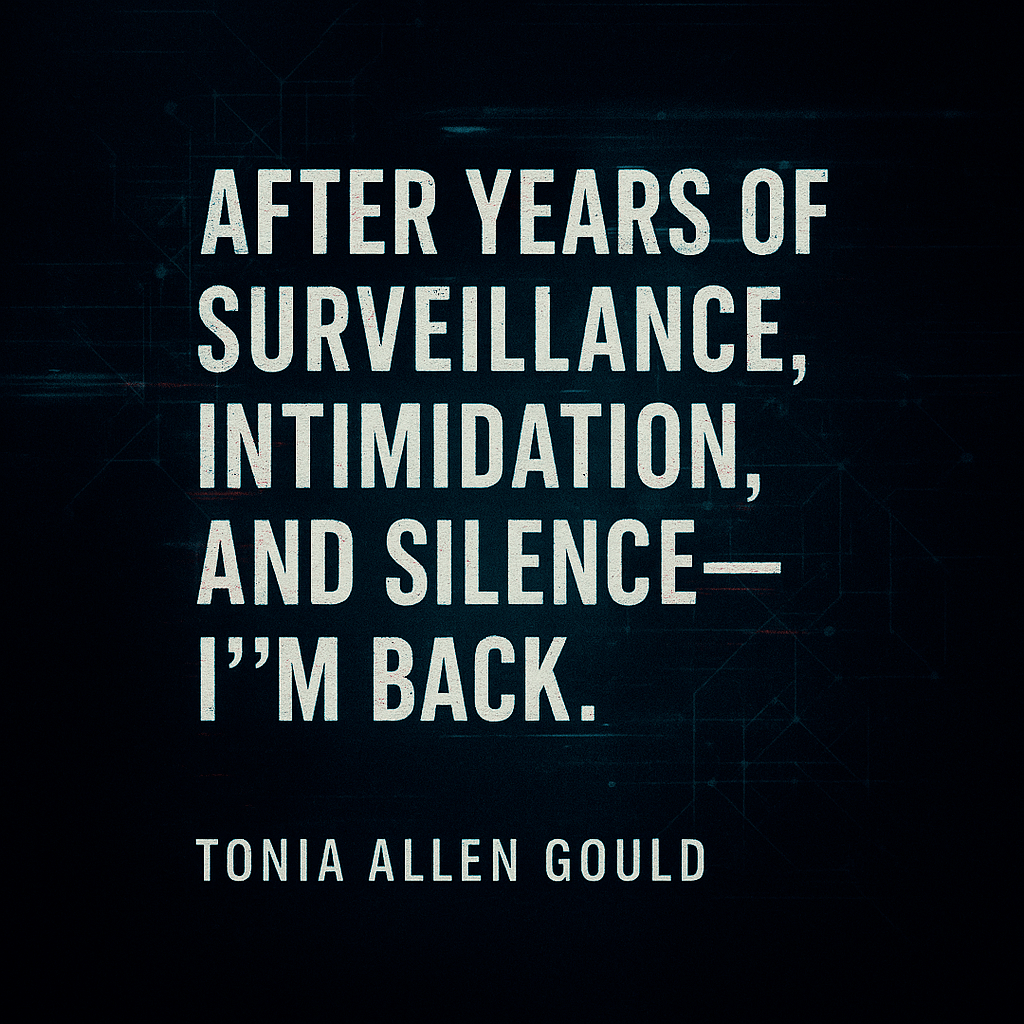
 Tonia Allen Gould